Arriving to myself
"Now I get to be who I am. I no longer have to live a double life!" — Joelle Marcelle Antson shares her journey of coming out as a trans woman and finding herself through the body.
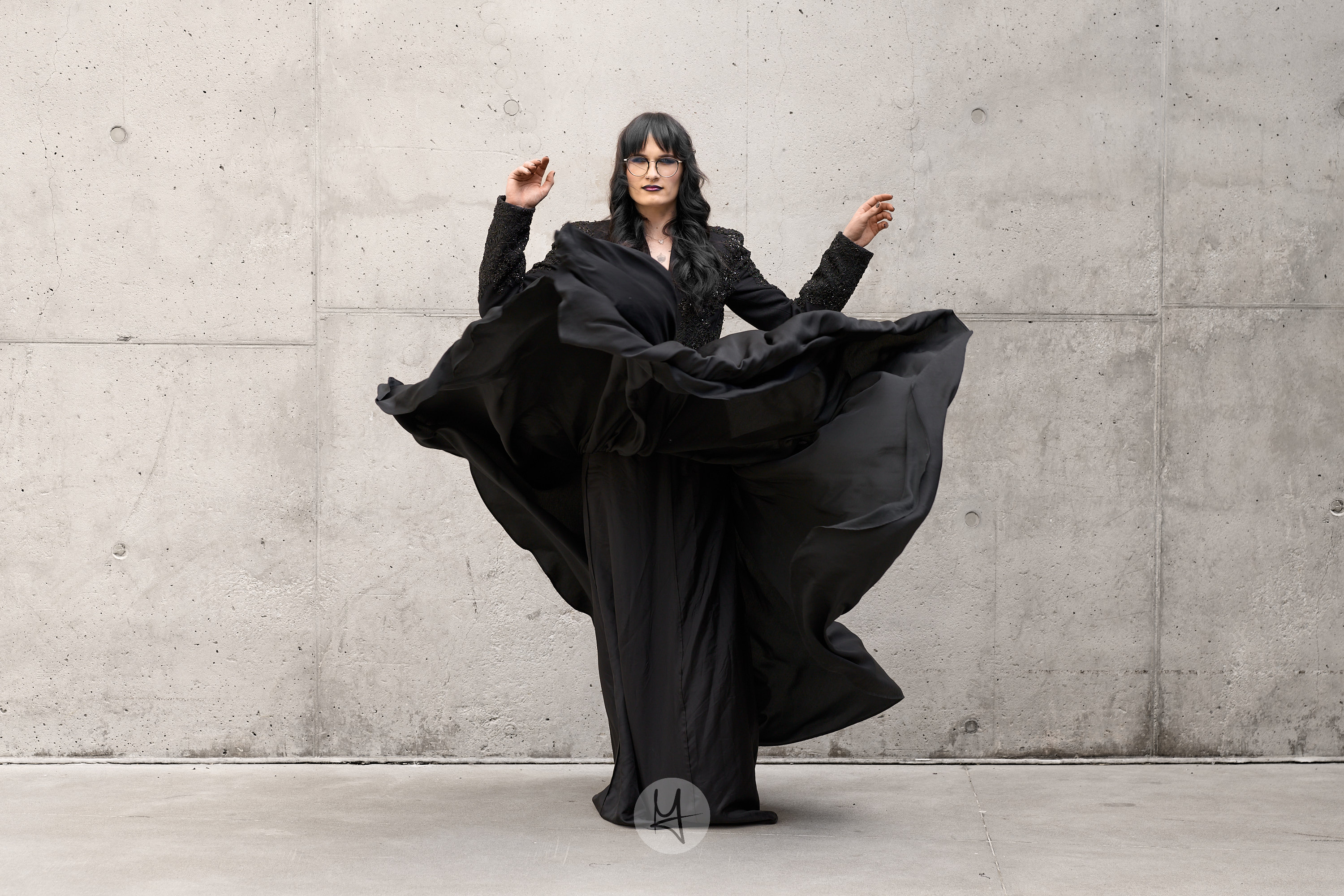
Text: Tiiu Suvi · Photos: Anna Meurer · Makeup & Hair: Liisa-Chrislin Saleh · Clothing: Taavi Turk
Originally published in Anne & Stiil, July 2025, in Estonian
“Now I get to be who I am. I no longer have to live a double life!” says Joelle Marcelle Antson (29), who publicly came out as a trans woman last fall.
“Dear friends, let me reintroduce myself,” wrote the somatic coach, restorative justice project manager at the Ministry of Justice and Digital Affairs, and spoken word artist on Facebook on October 1, 2024. “My name is Joelle Marcelle (she/her). I’m a trans woman and for the last few years, I’ve been going through a gender transition. In many ways, I’m still the same person you’ve known me as, only truer, softer, and prettier. /…/ What little Joelle dreamed of, teenage Joelle was too ashamed of, and the young adult Joelle was too afraid to admit, through the support of my coaches, friends, and my dear-dear body, I’ve finally had the courage to step into.”
Her facial features and voice are noticeably softer than a few years ago, and she has grown her hair long. Sometimes she wears bold makeup; today, she’s makeup-free, dressed in androgynous all-black clothing.
“People sometimes talk about trans folks as being ‘born in the wrong body,’ and that may fit some, but my body is good and wise,” says Joelle, who has a natural ability to focus on the positive. “Not on what I want to fix, but on what I long to welcome more of into my life, and what steps I need to take to make that happen.” She emphasizes that just like any group of people, trans people are not a monolith — she speaks only for herself and recognizes that others may not share her views. She shares her story so openly to offer more support for trans people and their loved ones. “I’m also neurodivergent. Discovering my gender identity and my neurodivergence have unfolded in parallel,” Joelle adds.
Feeling different
The identical Antson triplets gained attention already as toddlers, and even more so as teens when they started a band and worked as models.
“Being a multiple, being a boy was never just a personal identity — it was always collective,” Joelle says. “We were seen as a group first, not as individuals. The media focus on our identical appearance left little room to be different — especially in terms of gender. As a child, it was hard to understand that something was wrong, because I had no knowledge of trans people. But it wasn’t me who was wrong — it was the way people saw me.”
“I prayed to be a beautiful woman with long blond hair.”
Joelle’s first memories of feeling different go back to when she was about five. “I was under the blanket, crying, wishing and praying that I would grow up to be a beautiful woman with long blond hair,” she recalls. That image haunted her, but she suppressed it mercilessly. She didn’t know anything about trans people at the time and only came across them on social media 10 to 15 years later. She had no idea gender transition was even possible in Estonia, let alone accessible for her.
“I feel like so much of my life went unlived because I was forced into a shape that didn’t fit. It brought a lot of depression and pain,” she reflects. “Trans people are at much higher risk for suicide than cisgender people — not because of our identity, but because of the social misunderstanding and condemnation we experience. I carried a lot of repressed feelings and deep shame. I thought, okay, maybe I can wear women’s clothes at home, but I’ll never be able to live openly as a woman.”
Finding herself far from home
At the café, Joelle orders an American Hot Chocolate topped with whipped cream and a cherry. Fittingly, her rebirth began in America in 2016. “I felt free to explore myself more, slowly and quietly at first. I was in a relationship where I shared my feelings for the first time, and my partner was fairly supportive,” she recalls. But when that relationship ended, she returned to Estonia and the freedom she’d tasted evaporated. “The first seed had been planted, but it came with a lot of shame and anxiety again,” she says. “I even blocked a U.S. friend who changed their name — I felt I couldn’t see other trans people or I wouldn’t be able to keep the lid on myself.”
Joelle returned to the U.S. in 2019 for graduate studies — one of the best periods of her life. She studied in Nashville, not the most progressive city, but her school, Vanderbilt Divinity School, was. It had a strong LGBTQ+ community. She later found out that unless you said you were straight, classmates assumed you were in some way queer. Joelle bought her first skirt, which she wore at home — but not yet in front of friends. She regrets that now, knowing that most of her close friends were trans and would have been supportive. “But I couldn’t yet accept that I was a woman — it was a complete taboo!” she admits.
After losing her job during the COVID crisis, Joelle returned to Estonia again. In late summer 2021, she accidentally came out to her then-partner. “It was a hard conversation. She was very unsupportive. She said, ‘Why didn’t you tell me before? I wouldn’t have dated you at all,’” Joelle recalls. In the following six months, she came out to her U.S. friends through video calls. Though small and pixelated, those boxes offered vast space for self-understanding. Knowledgeable friends said: these feelings might mean you’re trans — or not. Joelle explains: “In a cis-heteronormative world, if you’re born with a penis, you’re told: you’re a man, dress like one, and you have to like women. But gender expression can be feminine even if you identify as a man — or vice versa. There’s a difference between gender expression, gender identity, and sexual orientation.”
Call me by my name
Joelle spoke individually with each of her family members. “My biggest fear was how my family would react. Being a multiple was the biggest reason it took me so long to admit I’m a woman,” she shares. “I spent my life worrying how hard it would be for them — and still, I was shocked at how hard it actually was. The first conversations weren’t what was the hardest, but what followed was. For a couple of years, I distanced myself from some family members to make things easier.”
“Unfortunately, for most trans people, family relationships are very difficult.”
Joelle urges people: when someone comes out to you — about being trans, queer, or anything else — don’t make it about you! “Don’t center your feelings or put yourself first. Don’t question their words just because it’s not the ‘born in the wrong body’ narrative you expected,” she says. “Be open. It’s okay to ask questions and make mistakes — just show that you’re trying. If someone says they accept me but doesn’t change their behavior, that love doesn’t reach me — because love is an action, not just a feeling. I don’t care much what people think of me — but I do want them to respect me enough to use the right name and pronouns.”
In Joelle Marcelle’s name, the final es are silent, and the stress is on the last syllable. Calling a trans person by their former (usually birth) name — known as “deadnaming” — when done intentionally or repeatedly is deeply hurtful. Imagine how you’d feel if someone deliberately mispronounced your name?
Freed energy
Coming out as trans and the time afterward can bring major change for loved ones — sometimes even a sense of grief that takes time to process. “But if your family member has finally found the courage to come out and feels more alive than ever, hearing about your grief can be incredibly painful for them,” says Joelle. “Don’t remind them how hard their joy is for you. Your feelings are valid, but you should seek support elsewhere — like from support groups for families of trans people.”
Her family relationships have improved — some were supportive all along. There have been tender moments: her siblings have done photo shoots with her, her father helped prepare her hormone therapy celebration, and her mother called on her coming-out night to ask how it went. Still, most trans people face serious family struggles.
Unexpectedly warm support also came from surprising sources — colleagues she barely knew, acquaintances on social media. Joelle was deeply moved. Of course, there were vile hate messages like “you sick freak, move to Sweden,” but even in replying to some of them, she found a positive note, noting that carrying such hate must be exhausting.
“Once I’d come out on social media and at work, it all just became part of normal life,” Joelle smiles. “I no longer had to hide or live a double life! So much energy was freed. Now I get to be who I am. That outweighs every hurtful comment.”

Two years of waiting
It can get tiring to answer the same questions repeatedly, Joelle admits, recognizing that public knowledge of trans issues is still lacking. She was surprised that even some healthcare workers showed ignorance. “A doctor should trust my experience and still not expect me to educate them on trans health care,” she says. “Unfortunately, our system requires a commission to approve hormone therapy and legal gender change. The queue is very long — currently over three years. I waited ‘only’ for two.”
The first commission meeting, to get hormone approval, made her very anxious. The second, for legal gender change, was more of a formality, and even a pleasant experience. The members asked how she was doing and how satisfied she was with the transition. “Since I’m a spoken word artist and with high verbal acuity, I can express my thoughts well,” Joelle says. “But for many, the process is hard — especially for nonbinary people, who aren’t granted access to hormone therapy. I wish everyone could have the choice to be informed of the risks and benefits and make a supported decision. Regret rates for gender transition are under 1% — due mostly to social pressures. That kind of success rate would be a medical miracle for any other procedure!”
Not just “that” surgery
Joelle believes those most affected by a situation are best equipped to solve it. “Nothing about us without us,” she quotes. A comprehensive trans website with a glossary and media guide was developed by trans people themselves. Among other things, it explains that instead of the stigmatizing term “sex change operation,” the correct term is “gender transition.” “We’re not switching from one to another — we’re acknowledging who we’ve always been. Birth-assigned gender is a label others gave us, but if it doesn’t match our gender identity, then it’s the wrong label!”
“Living as a woman is generally more expensive — especially when you’re making up for lost time.”
“Most trans people don’t want conversations to center on genitals, but that’s often the first question: are you having the surgery?” says Joelle. “But if you ask about finances, I’ll say they’re substantial. Replacing a whole wardrobe, doing hair, nails, laser hair removal, makeup — all of that adds up. Life is just more expensive as a woman, especially if you’re catching up! Hormones cost about €50 a month, plus doctor visits and regular checkups with an endocrinologist. Surgery costs vary widely and can reach tens of thousands depending on what’s involved — genital, chest, or facial surgeries. Expenses depend on individual needs and capabilities. Sadly, puberty blockers aren’t accessible in Estonia, which would greatly reduce the need for costly surgeries.”
Joelle wanted her physical changes to be subtle until she had come out. She started hormone therapy gradually. “In the first weeks, I felt my lips get bigger. Not only my body, hair, and skin softened — so did my emotions and sense of the world. Things no longer felt so abrupt, like they did on testosterone,” she laughs.
“Romantically, the more I’ve connected with my gender, the easier it’s been to accept my sexual orientation,” says Joelle, who is currently single. “It was actually harder to admit I’m also attracted to men than to admit I’m a woman. Trans women are mostly pursued by straight men, but many won’t admit it — they fear it means they’re gay. When they find out I’m trans, they often deny their attraction or only want to meet in secret, never in public.”

Just as you wish
Joelle wants to dedicate more time to coaching, supporting not just trans people but also their loved ones and neurodivergent individuals. “Cis people might find it hard to understand someone wanting to transition,” she says. “But if you know your gender identity and expression, then so do I, too. That understanding could be a bridge between us. Trans people challenge the rigid gender roles we’re boxed into — like, if you’re assigned male, you’re allowed two emotions: anger and lust, but not tears. You can play with cars, but not dolls. Pants are fine, dresses not. These are socially constructed ideas. Realizing that can be scary — but also liberating.”
Joelle plays the hymn-like song “Every Body” on her phone, a song she wrote a few years ago. She wonders if she should record it again with her current voice, because in the past, she intentionally lowered her voice. However, it seems more honest to leave it as it is.
“All of us should have the right to listen to the messages of our bodies, which means both joy and euphoria, as well as discomfort and dysphoria. Both help you reach what makes you feel alive,” Joelle says. For the first time, after doing makeup, she looked into the mirror and felt an overwhelming joy and warmth spreading through her body. “It’s like coming home after a long time away,” she reflects.
“I want to tell trans people: the world is much more beautiful because you are here! And only you know how your journey unfolds. Take as much time as you need. Find people around you with whom your body can relax and not feel the need to hide. You definitely don’t have to try to be a cis-man or cis-woman. Your opportunity is to create your own version of masculinity, femininity, or think completely outside the binary box. We can be exactly who we are meant to be.”
Terminology
- Gender identity refers to a person’s internal sense of gender — how they experience and understand their own gender. It may or may not align with the sex they were assigned at birth. One cannot determine someone’s gender identity based on appearance, voice, gestures, or behavior.
- Gender expression is how a person manifests their gender externally, such as through clothing, body language, and social behavior. Gender expression is more diverse than just “masculine” or “feminine,” and it does not necessarily indicate someone’s gender identity.
- Sexual orientation indicates whom a person feels affection for — romantic and sexual attraction — and whether they wish to form intimate relationships with people of the same sex, another sex, multiple sexes, or regardless of sex.
Core concepts
- Assigned gender at birth (AGAB) refers to the sex (male or female, in Estonia) assigned at or shortly after birth based on external anatomy. This determines legal sex and how one is raised. It may not reflect internal gender experiences or future gender identity.
- Cisgender (cis) describes a person whose gender identity matches their sex assigned at birth.
- Nonbinary is an umbrella term for gender identities that fall outside male/female, including those who identify as multiple genders (multi-gender), no gender (agender), or fluid gender (genderfluid).
- Genderqueer signifies a strong rejection of societal norms regarding gender identity or expression.
- Transgender (trans) is someone whose gender identity differs from the sex assigned at birth. It’s not a category of identity but describes the relationship between identity and assigned sex. Being transgender is not a medical condition, though many trans people may pursue gender-affirming healthcare.
- Gender transition is the process by which a trans person begins living in accordance with their gender identity. It can involve psychological changes, social changes (name, pronouns, clothing), physical changes (through exercise or medical care), and legal updates (name, ID gender marker). Unlike “sex change,” which is stigmatizing, “gender transition” encompasses a broader, more nuanced journey.
Source: transinimesed.ee